Orange Springs Overview
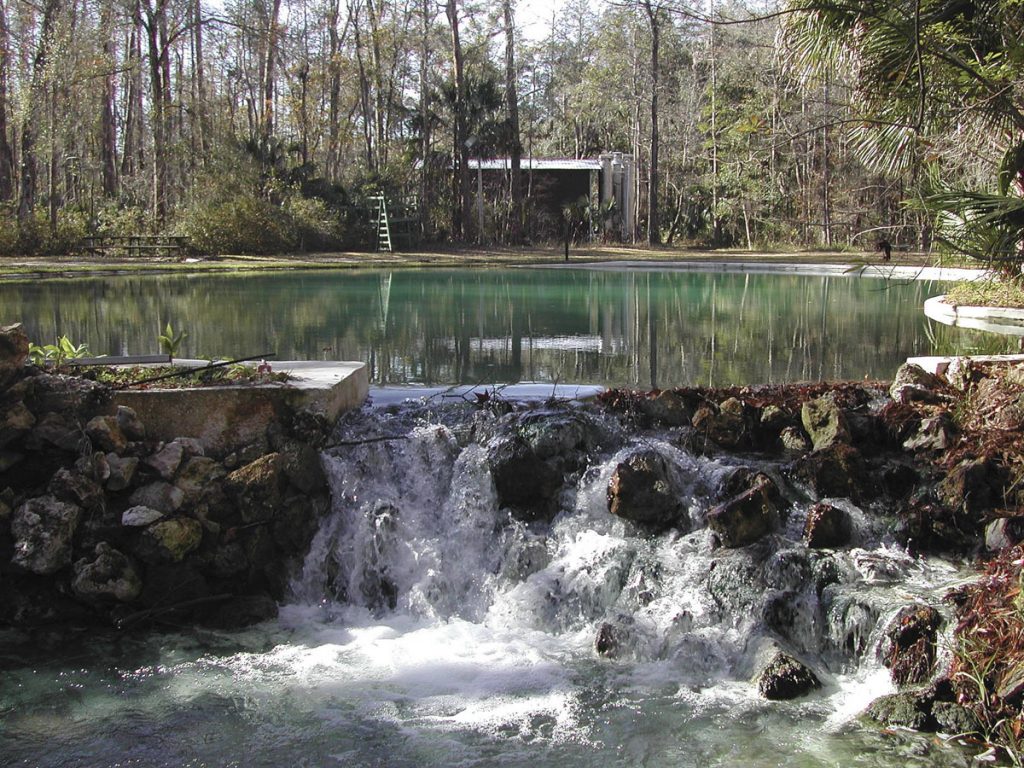
Executive Summary
Applicant: Fountara, LLC
Project: Orange Springs, Seminole Spring & Orange Creek System Restoration & Preservation
Location: Corridor spanning Seminole Spring and Orange Springs headwaters (Marion County) down Orange Creek into Putnam and Alachua counties, encompassing the James W. Townsend House (NRHP #98001343).
This grant proposal aims to preserve and restore one of North Florida's most interconnected freshwater and cultural systems. The project integrates Seminole Spring, Orange Springs, and the Orange Creek–Orange Lake–Lochloosa Lake corridor, addressing ecological, hydrological and historic‑preservation priorities under a single multi‑county plan.
- Safeguard and document Seminole Spring and Orange Springs headwaters.
- Remove invasive vegetation, fallen trees and accumulated muck to restore natural flow and oxygenation.
- Stabilize eroding banks and re‑establish native vegetation across riparian zones.
- Conduct archaeological and burial‑site assessments prior to disturbance to protect cultural resources.
- Stabilize and preserve the James W. Townsend House, a key heritage landmark.
Scope of Work & Phases
Phase 1 – Archaeological & Burial‑Site Survey
State‑licensed survey across Seminole Spring, Orange Springs and the Orange Creek corridor to identify and protect cultural or burial sites in coordination with tribal representatives.
Phase 2 – Creek & Spring Restoration
Remove muck, debris and invasive plants from Seminole Spring and Orange Springs downstream to Rodman Reservoir, Orange Lake and Lochloosa Lake; restore hydrology and oxygen levels while minimizing mechanical disturbance.
Phase 3 – Vegetation & Shoreline Stabilization
Replant native wetland and upland species using bio‑engineering methods such as coir logs, root matting, live staking and native sod to stabilize banks.
Phase 4 – Historic & Cultural Preservation
Stabilize and rehabilitate the James W. Townsend House following the Secretary of the Interior's Standards and produce documentation and interpretive materials for public education.
Phase 5 – Conservation Buffer & Monitoring Network
Establish vegetated buffers linking the springs and creek; implement quarterly monitoring of vegetation, erosion and water quality with annual reporting to DEP and DHR.
Phase 6 – Future Infrastructure Planning
Plan for monolithic dome emergency shelters and renewable‑powered water storage facilities after restoration objectives are met; these components are not included in current funding.
Expected Outcomes & Performance Indicators
- Restored hydrologic connectivity across ≥15 miles of the Seminole–Orange–Orange Lake–Lochloosa corridor.
- ≥90 % reduction in invasive biomass and ≥75 % native cover within 12 months.
- Improved shoreline stability and reduced erosion by ≥60 %.
- Verified archaeological compliance and protection of burial sites.
- Stabilized and preserved James W. Townsend House for future interpretation.
- Creation of a regional conservation and education corridor with volunteer and community involvement.
Key Metrics
| Metric | Target |
|---|---|
| Linear miles restored | ≥ 15 miles continuous flow |
| Invasive biomass removal | ≥ 90 % reduction |
| Native vegetation coverage | ≥ 75 % within 12 months |
| Shoreline stability gain | ≥ 60 % erosion reduction |
| Archaeological compliance | 100 % DHR approval |
| Townsend House preservation | Complete stabilization |
Background & Need
The Orange Springs–Seminole Spring–Orange Creek system forms one of Florida's most significant freshwater corridors, flowing from two spring heads through Putnam County into Rodman Reservoir and west into Orange and Lochloosa Lakes. Despite relatively high water quality, the system is threatened by invasive vegetation, debris, bank erosion and hydrologic fragmentation from decades of unmanaged obstruction and aging infrastructure. The James W. Townsend House, built in the late 1800s and listed on the National Register of Historic Places, sits at the heart of this landscape. Preservation of the house and associated archaeological resources—as well as the springs and waterway—supports cultural heritage, ecological health and regional water resilience. Without intervention, invasive biomass and erosion will continue to reduce oxygen levels and degrade habitats, burial resources may be unintentionally disturbed and the Townsend House risks further deterioration. Immediate multi‑county restoration is necessary to protect these irreplaceable natural and cultural assets and to fulfil objectives of the Florida Springs Restoration Initiative, St. Johns River Water Management District and the Florida Division of Historical Resources.
Goals & Objectives
Primary Goal: Restore and protect the Seminole Spring–Orange Springs–Orange Creek–Orange Lake–Lochloosa Lake system while preserving the James W. Townsend House and associated cultural resources, ensuring long‑term ecological integrity, historical continuity and community resilience.
Objective Highlights
- Water Quality: Monitor and maintain high‑quality water by removing nutrient‑laden muck and reducing runoff via vegetated buffers.
- Hydrologic Connectivity: Reconnect the corridor by removing debris and invasives and restoring natural flow gradients.
- Invasive Removal & Native Planting: Remove hydrilla, torpedo grass and other invasive species; replant native wetland and upland vegetation using bio‑engineering methods.
- Archaeological & Burial Protection: Perform Phase IA/IB surveys and coordinate with DHR and tribal representatives; halt work if remains are discovered.
- Historic Preservation: Stabilize and rehabilitate the James W. Townsend House with appropriate materials and interpretive signage.
- Conservation Buffer & Monitoring: Create vegetated buffers, conduct quarterly environmental monitoring and share data publicly.
- Community Partnerships: Formalize multi‑county agreements, engage private partners and volunteers and establish educational programs.
- Future Resilience: Plan for long‑term infrastructure like monolithic domes and pollinator meadows, with independent environmental review.
Implementation & Timeline
The project will run over 24 months with subsequent monitoring for five years. Work phases overlap strategically to maintain momentum and ensure that no physical activity begins before cultural clearance. Key milestones include completion of archaeological surveys by Month 3, mid‑point hydrologic restoration by Month 6, invasive removal by Month 9, Townsend House restoration by Month 14 and buffer installation and monitoring launch by Month 18. Planning for future emergency shelters occurs in Months 20–24, followed by quarterly and annual monitoring through Years 3–7.
| Phase | Duration | Main Deliverables |
|---|---|---|
| 1 – Archaeology & Burial Survey | Months 1–3 | CRAS report and DHR clearance |
| 2 – Creek & Spring Restoration | Months 3–9 | Debris removal, flow restoration and oxygenation |
| 3 – Vegetation & Shoreline Stabilization | Months 9–15 | Native planting, erosion control and invasive follow‑up |
| 4 – Historic Preservation | Months 10–16 | Stabilization and restoration of Townsend House |
| 5 – Buffer & Monitoring | Months 16–20 | Vegetated buffer installation and monitoring program launch |
| 6 – Future Infrastructure Planning | Months 20–24 | Feasibility studies for dome shelters and canning facilities |
Budget Overview
Fountara, LLC requests full grant funding for both environmental restoration and historic preservation. Costs are allocated across project management, archaeological surveys, restoration activities, vegetation stabilization, monitoring, conservation buffers and specialist consultants. Separate budgets cover restoration ($1.375 million) and historic preservation ($1.15 million), with a combined total of $2.525 million. All partner contributions are treated as in‑kind support, and a formal match‑waiver accompanies the application. Post‑grant maintenance will rely on county stewardship agreements, volunteer programs and additional grants, ensuring long‑term sustainability.
Long‑Term Sustainability & Monitoring
Following the two‑year restoration period, quarterly water‑quality and vegetation surveys will continue for five years. Annual reports to DEP, SJRWMD and DHR will track progress against key metrics. A stewardship framework assigns responsibilities to Fountara, state agencies and county partners for hydrology, vegetation, cultural sites, the Townsend House and monitoring networks. Maintenance funding will come from county agreements, dedicated stewardship funds, additional grants and volunteer support. After Year 15, the site will transition to heritage‑park status managed by Fountara and the counties. Future risk management includes invasive control, storm damage protocols, funding reserves and structural inspections. A renewable energy component and plans for emergency shelters will expand the project's resilience and community value.
Interactive Map
Explore the Orange Springs project area using the map below. Use the layer control to toggle data layers.